
Greater Melbourne is home to over 95,000 active NDIS participants — one of the largest concentrations in Australia. Yet most local providers are struggling to fill their caseloads. The reason is almost never service quality. It’s digital visibility.
Most Melbourne NDIS providers lose participants online because they rely on referrals rather than search, have incomplete Google Business Profiles, slow mobile websites, and no suburb-specific landing pages. Over 80% of NDIS participants and their families now search Google before contacting any provider.
As an NDIS SEO specialist working with providers across Victoria, I’ve audited dozens of Melbourne practices. Here is exactly why your participant enquiries may be low — and how to fix each issue.
1. The Problem: The Death of the LAC Referral Pipeline
Referrals from Local Area Coordinators and support networks are valuable — but they are not scalable, and they are not yours to control. LAC territories change. Referral relationships dry up. A new provider opens nearby and builds the relationship you assumed was permanent.
Meanwhile, data from NDIS participant surveys consistently shows that over 80% of participants and their families start their provider search on Google before making any contact. If your practice has no digital footprint, you simply don’t exist to the majority of Melbourne’s NDIS market.
| Feature | Traditional (LAC referrals) | Digital (SEO & local search) |
|---|---|---|
| Reach | Limited to your immediate LAC network | All Melbourne suburbs, all service types |
| Lead consistency | Slow, unpredictable, relationship-dependent | Steady organic enquiries, compounding over time |
| Control | Dependent on a third party’s priorities | Fully owned — no single point of failure |
| Scalability | Capped by the size of your referral network | Scales with content and location pages |
2. Your Google Business Profile: The Digital Front Door
In Melbourne, your Google Business Profile (GBP) is the single most visible asset you own online. For NDIS-related local searches, GBP listings appear above every organic result. Yet most NDIS providers have a profile that actively loses participants rather than converting them.
Here are the most common GBP gaps we see across Melbourne NDIS providers:
- Review gaps: A participant family in Doncaster or Werribee will rarely contact a provider with fewer than 8 Google reviews or a rating below 4.5. NDIS decisions are high-trust and high-stakes — social proof is non-negotiable. If you have under 10 reviews, collecting them is your single highest-ROI action this month.
- Missing service categories: GBP allows you to list specific NDIS support categories — Support Coordination, Plan Management, Daily Activities, SIL. Providers who leave these blank are invisible for category-specific searches from participants and plan managers.
- No participant-facing photos: Photos of your team, your accessible office, and your staff with participants (with appropriate consents) signal trust. Profiles with no photos receive dramatically fewer profile visits than those with 10 or more images.
- No posts or updates: GBP allows weekly posts — new services, staff updates, NDIS price guide changes. Providers who post regularly signal to Google that they are an active, legitimate business, improving local pack ranking.
Melbourne-specific note: Participants searching in inner suburbs like Fitzroy, St Kilda, and Brunswick expect immediate digital credibility. Outer suburb participants in Frankston, Dandenong, and Cranbourne are often underserved a complete GBP targeting these areas faces almost no competition and can rank in the local pack within weeks.
3. Website Speed: The 3-Second Rule for NDIS Enquiries
The majority of NDIS participant searches happen on mobile devices often by carers and family members researching providers on the go, or participants themselves searching between appointments. If your website takes more than 3 seconds to load, most of those visitors are already gone before your page renders.
Participant drop-off rate by website load speed:
- 0–2 seconds (optimal) 9% drop-off
- 3–5 seconds 38% drop-off
- 6+ seconds 70%+ drop-off
For Melbourne NDIS providers, slow websites are especially costly because participants often search while assessing multiple providers simultaneously. A fast-loading site with a clear call to action converts participants who would otherwise close the tab and enquire with a competitor.
Google’s Core Web Vitals — the technical benchmarks behind page speed scoring — are also a direct ranking factor. A site that fails Core Web Vitals is penalised in organic rankings before a participant even sees it. Run your site through Google PageSpeed Insights today and aim for a score above 80 on mobile.
4. Keyword Strategy: Stop Targeting “NDIS Melbourne”
The single most common keyword mistake Melbourne NDIS providers make is targeting city-wide terms like “NDIS Melbourne” or “NDIS provider Victoria.” These terms are dominated by large multi-national platforms (Hireup, Mable, My Community Directory) with domain authorities you cannot compete with directly. The opportunity is in the suburbs.
A smart NDIS SEO strategy uses suburb-specific, service-specific keywords that match exactly how participants search:
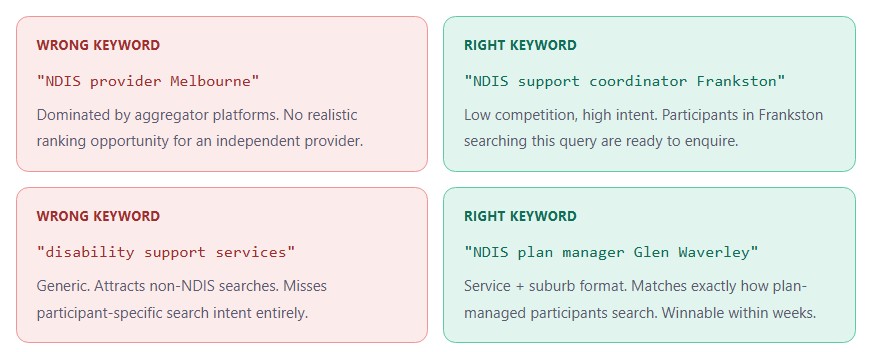
The highest-opportunity Melbourne suburbs for NDIS SEO right now are areas with large participant populations and low provider digital competition: Frankston, Dandenong, Cranbourne, Werribee, Hoppers Crossing, Sunshine, Broadmeadows, and Pakenham. Build one suburb landing page per location you serve each targeting a “[service] [suburb]” keyword and you will outrank competitors who only have a single generic homepage.
5. The Participant Experience Gap: How You Handle Enquiries
The Melbourne NDIS market is competitive and fast-moving. When a participant or their support coordinator submits an enquiry, they are typically contacting 3–5 providers simultaneously. If you do not respond within 30 minutes during business hours, the participant has often already booked a consultation elsewhere.
This is not just a customer service issue — it is an SEO issue. Google’s local ranking algorithm surfaces providers who generate positive engagement signals: enquiries submitted, calls made, directions requested. Providers who convert enquiries signal to Google that they are a trusted, active business. Those who don’t convert are gradually deprioritised.
Quick win: Add an automated confirmation email or SMS to your contact form that fires immediately on submission. It should say: “Thank you for reaching out. A member of our team will contact you within [X hours] to discuss your NDIS support needs.” This holds the participant’s attention and reduces the chance they move on to the next provider on the list.
Your enquiry form itself also matters. NDIS participants and carers are often managing complex situations — a form that asks for too much information before offering any value will be abandoned. Ask only for name, phone, and service type at the first step. Everything else can come in the follow-up call.
6. The NDIS Planning Cycle Strategy
Unlike most service businesses, NDIS providers operate within a predictable participant planning cycle. You cannot run the same content and keyword strategy year-round and expect consistent results. Your SEO must align with the moments participants are most actively searching.
| NDIS cycle moment | Participant behaviour | SEO / content focus |
|---|---|---|
| Plan review approaching (6–8 weeks prior) | Researching providers, comparing services, seeking recommendations | Comparison content, “how to switch NDIS providers” AEO pages, suburb landing pages |
| New plan activated | Urgently searching for specific support types to start using funding | Service-type pages with clear onboarding CTA, fast contact form, GBP “open now” signals |
| Mid-plan (funding running low) | Searching for plan management or support coordination to optimise remaining budget | Blog content targeting “how to make my NDIS funding last” and plan management queries |
| Post-review (new participant) | First-time participant, unfamiliar with providers, high Google search volume | Definitional AEO content: “what is NDIS support coordination”, “how to find an NDIS provider” |
Publishing content and updating your GBP in anticipation of these planning cycle moments — rather than reacting to them — is what separates Melbourne NDIS providers who consistently attract new participants from those who scramble to fill caseloads after plan reviews pass.
3 Steps to Increase Your Participant Enquiries This Month
Optimise your Google Business Profile completely
Verify your NDIS registration number, list every support category you provide, upload 10+ photos, and publish a GBP post this week. If you haven’t collected Google reviews from current participants (with their consent), begin today. Aim for 15+ reviews above 4.5 stars before your next plan review season.
Build suburb landing pages for every area you serve
Create a dedicated page for each Melbourne suburb in your service area, targeting “[your service] [suburb]” keywords. Include the suburb name in the H1, meta title, and first paragraph. Add real local context — participant counts, local LAC office details, nearby NDIS-accessible locations. These pages are the fastest route to ranking for the low-competition local queries your ideal participants are already typing right now.
Add AEO-structured FAQ content to every service page
Add a FAQ section to each service page answering the 5 most common questions your participants ask before enquiring. Write each answer in 40–60 words and add FAQPage schema markup. This is the fastest way to win Google Featured Snippets for NDIS queries in Melbourne — appearing above every organic result, including competitors with higher domain authority than yours.
Claim Your Free Melbourne NDIS SEO Audit
Stop guessing why your competitors are filling their caseloads while yours stays flat. Get a clear, jargon-free report on your current digital performance — free. Request Your Free Audit
- Google Business Profile health check — is your profile visible in Melbourne local search?
- Keyword gap analysis — which high-value Melbourne suburbs are you missing?
- Speed and mobile test — is your site losing 70% of participants before they enquire?
- Competitor comparison — see exactly what top-ranking Melbourne NDIS providers do differently.
No lock-in. No strings. Just honest data to help you attract more participants.
Final Word: Don’t Let Your Participants Find Someone Else First
In Melbourne, your quality of care is only half the equation. If your digital presence is invisible, participants who need exactly what you offer will find a competitor first — not because they’re better, but because they showed up on Google and you didn’t.
The gap between an undersubscribed NDIS practice and a fully booked one is almost always a handful of fixable SEO and AEO adjustments. A complete Google Business Profile. Five suburb landing pages. FAQ schema on your service pages. These are not expensive or complex changes — but they compound every month they’re live.
Ready to stop losing participants to providers who rank above you? Start with the free audit above, fix the issues it surfaces, and watch your Melbourne enquiry rate climb before your next plan review season arrives.
Rupert Corpuz
NDIS SEO Specialist · The Purple Arrow · Melbourne, VIC
Related guides
NDIS SEO Melbourne →What is AEO? →SXO vs SEO →SEO for Support Coordinators →NDIS SEO Frankston →NDIS SEO Dandenong →Free audit →