

Whether you’re an NDIS participant looking for help navigating your plan or a support coordination business trying to reach more participants online this guide covers everything you need to know.
646k+ active NDIS participants in Australia
3 levels of support coordination available
73% of NDIS searches start on Google, not the portal
What is an NDIS support coordinator?
An NDIS support coordinator is a professional who helps National Disability Insurance Scheme participants understand, implement, and make the most of their NDIS plan. Think of them as a knowledgeable guide — someone who knows the NDIS inside-out and whose job is to make the system work for you, rather than the other way around.
The NDIS can be genuinely complex. Plans contain multiple funding categories, support budgets, and eligibility rules that vary depending on how a plan is managed. For participants who are newly approved, recently reviewed, or navigating significant life changes — finding the right services, setting up agreements, and staying on top of spending can feel overwhelming. That’s precisely where a support coordinator steps in.
Key definition: According to the NDIS, a support coordinator helps participants understand and implement their plan, connects them with NDIS providers, community services, and other government supports, and builds their confidence and skills to manage their supports over time — ultimately working towards greater independence.
It’s important to distinguish support coordinators from support workers. A support worker provides hands-on day-to-day assistance — personal care, transport, community access. A support coordinator operates at a strategic level: they organise, connect, problem-solve, and advocate, but they don’t provide direct personal support themselves.
It’s also worth separating support coordination from plan management. A plan manager handles the financial side of your NDIS plan — processing invoices from providers and managing your budget. A support coordinator focuses on the coordination and implementation of your supports. Many participants use both.
The 3 levels of NDIS support coordination explained
The NDIS funds three distinct levels of support coordination, each designed for different participant needs and plan complexities. Understanding which level applies to you is the first step in finding the right coordinator.
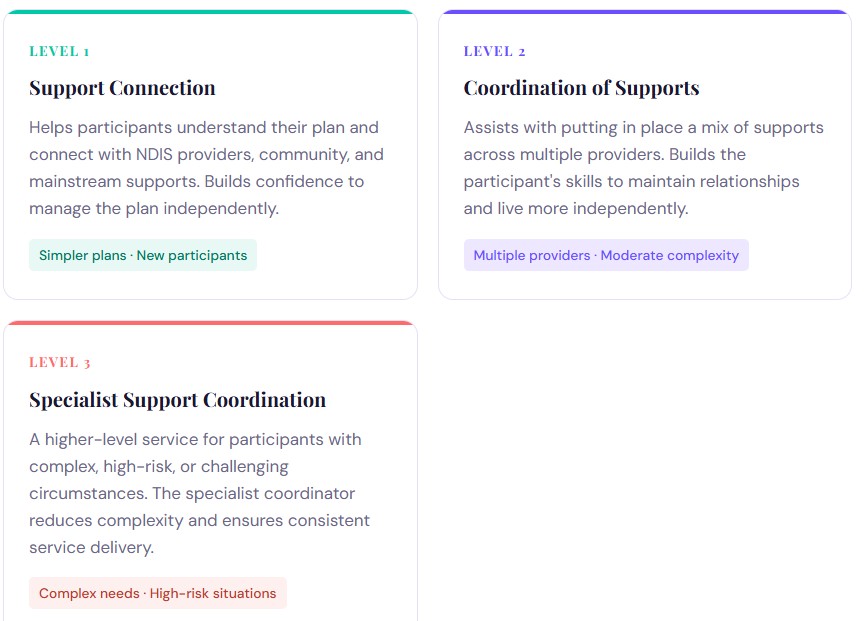
Your NDIS plan will specify which level of support coordination is funded, based on what the NDIA determines is reasonable and necessary for your circumstances. If the level is not stated in your plan, you have the flexibility to choose the level that best suits your current needs.
Participants with particularly complex circumstances may have both Level 2 and Level 3 coordination funded simultaneously — for example, specialist coordination to address immediate barriers alongside ongoing coordination of supports for the remainder of their plan period.
Practical tip: If you feel your current level of support coordination isn’t meeting your needs or if your circumstances change significantly you can discuss a plan review with your NDIA planner or LAC. Your support coordinator can help you prepare for this process.
What support coordinators actually do
The role of an NDIS support coordinator spans a broad range of activities. While the specific tasks will vary depending on the participant’s level of coordination and individual circumstances, the following covers the core functions you can expect from a good coordinator.
Understanding your plan
Before anything else, a support coordinator will sit with you to make sure you genuinely understand your NDIS plan. This means going through your support budgets, the categories of funding available to you, what can and cannot be claimed, how much can be spent and when, and what requirements such as service bookings or quotes might apply to specific supports.
This initial “plan unpacking” stage is foundational. A participant who understands their plan is empowered to make real choices about how their supports are delivered.
Connecting you with providers
A significant part of the role involves researching, identifying, and connecting participants with suitable service providers. A good coordinator will have strong knowledge of local providers across relevant support categories — therapy services, accommodation, community access, daily activities, and more — and will help you understand your options so you can make informed decisions.
Your coordinator should also know about mainstream and community services that may be available to you beyond NDIS funding — things like local councils, health services, and community organisations.
Setting up service agreements
Once you’ve chosen your providers, your support coordinator can help you set up service agreements. These documents outline the terms of service delivery — what support will be provided, how often, at what cost, and under what conditions. A coordinator will help you understand and negotiate these agreements, including travel and cancellation policies.
Monitoring and reviewing your supports
Support coordination isn’t a one-off task — it’s an ongoing relationship. Your coordinator should regularly check in on how your supports are working, identify any issues or changes in your needs, and help you adjust your plan or providers accordingly.
Preparing for plan reassessment
Plan reviews are a critical moment in any participant’s NDIS journey. Your support coordinator plays a key role in helping you prepare — documenting what worked, identifying gaps, evidencing outcomes achieved, and making the case for any changes to your funding or supports. This can make a significant difference to the outcome of your review.
Safeguarding and advocacy
Support coordinators are often the first to become aware of concerns about the quality or safety of a participant’s supports. They have a responsibility to act on these concerns — connecting participants with advocacy services, assisting with complaints to the NDIS Quality and Safeguards Commission, and supporting participants to understand and exercise their rights.
How to find a support coordinator near you
Finding the right support coordinator is one of the most important decisions an NDIS participant can make. Here are the main pathways available to you in Australia.
NDIS Provider Finder
The official NDIS website includes a Provider Finder tool where you can search for registered support coordination providers in your postcode. This is the most comprehensive database of registered providers and allows you to filter by support category, location, and registration status.
Through your LAC or NDIA planner
If you’re new to the NDIS or recently had your plan approved, your Local Area Coordinator (LAC) or NDIA planner can often suggest local support coordination providers. This can be a useful starting point, particularly if you don’t yet know the local provider landscape.
Recommendations from your network
Word-of-mouth remains one of the most reliable ways to find a good coordinator. Other NDIS participants, disability advocacy organisations, allied health providers, and community groups can be excellent sources of genuine recommendations.
Online search
For many families, a Google search is the starting point. Searching terms like “NDIS support coordinator [your suburb or city]” will surface local providers. Look carefully at their websites — do they explain their approach clearly? Do they list the support categories they work in? Are there real client testimonials? A well-maintained, informative website is often a good indicator of a professional operation.
| Check that the coordinator is registered with the NDIS Quality and Safeguards Commission if your plan is NDIA-managed |
| Ask about their experience with your specific disability type or support needs |
| Confirm they have capacity to take on new participants in your area |
| Ask how they communicate and how often you can expect to hear from them |
| Clarify whether they have connections with providers in the specific categories you need |
| Ask what happens if your coordinator leaves the organisation |
What to expect from great support coordination
Not all support coordination is equal. The difference between adequate and excellent coordination can have a profound impact on the quality of a participant’s life and their ability to pursue their goals. Here’s what genuinely good coordination looks like in practice.
Clear and proactive communication
A great coordinator keeps you informed. You shouldn’t have to chase them for updates. They will proactively flag upcoming plan review dates, alert you when budgets are tracking low, and reach out if a provider raises any concerns about service delivery.
Local knowledge
The best coordinators have deep knowledge of providers, services, and community organisations in your local area — not just a generic national provider list. They know which providers have availability, which are well-regarded by other participants, and which to avoid. This local knowledge is particularly valuable in regional and rural areas where provider options may be limited.
A genuine focus on your goals
Your supports should always be oriented around the goals in your NDIS plan — not just filling in service hours. A skilled coordinator will keep asking: is this support helping you move towards your goals? They challenge the status quo and advocate for changes when the current arrangement isn’t working.
Genuine capacity-building
Good support coordination should, over time, make itself less necessary. The goal is for participants to build the skills and confidence to manage more of their own plan independently. A coordinator who creates dependency rather than capability is not serving a participant’s best interests.
What this means for coordinators: The shift towards self-managed and plan-managed participants now over 40% of the NDIS cohort means more participants are actively researching and choosing their own providers online. For support coordination businesses, a strong digital presence is no longer optional. Participants are making decisions before they ever pick up the phone.
Is support coordination funded in your NDIS plan?
Support coordination is funded under the Capacity Building budget in your NDIS plan, specifically within the Capacity Building — Support Coordination category. It is not automatically included in every plan — the NDIA determines whether it is “reasonable and necessary” based on your individual circumstances, goals, and support needs.
Participants who are more likely to have support coordination funded include those who are new to the NDIS, those with complex support needs spanning multiple service providers, those who have recently experienced a significant life change such as leaving school or transitioning out of hospital, and those from culturally and linguistically diverse backgrounds who may need additional support navigating the scheme.
If support coordination is not in your current plan but you believe it would benefit you, you can raise this at your next plan review. Your LAC or an advocacy organisation can assist you in making this case to the NDIA. Documenting specific examples of where additional coordination support would help you achieve your goals is the most effective approach.
SEO for NDIS support coordinators: growing your practice online
If you run or manage an NDIS support coordination business, this section is for you. The digital landscape for NDIS providers has changed dramatically in recent years and for support coordinators specifically, being visible online is now a primary driver of new participant enquiries.
Research consistently shows that 73% of people searching for NDIS providers start on Google, not the NDIS myplace portal or other official channels. That means participants and their families are forming judgements about providers and often making shortlists before they make any direct contact. If your business isn’t appearing prominently in those searches, you’re invisible to people who need you most.
Why NDIS support coordinator SEO is different
SEO for support coordination businesses isn’t just standard local business SEO with “NDIS” added to a few keywords. It requires a nuanced understanding of the NDIS ecosystem, participant and family search behaviour, the compliance obligations around how providers can communicate their services, and the trust signals that matter in a sector where participants are making high-stakes decisions about their care.
You’re also targeting two distinct audiences simultaneously. The first is participants and families searching for direct support. The second often overlooked is other NDIS professionals: allied health providers, LACs, and other coordinators who may refer to your service. These professional audiences search differently, use different language, and respond to different content signals.
The highest-impact SEO strategies for support coordinators
Location-specific service pages
Generic “support coordinator” pages don’t win local searches. You need dedicated pages for each suburb, LGA, or region you service with locally relevant content that goes beyond just inserting a place name. Pages that mention local providers, community organisations, relevant council services, and specific geographic context perform significantly better than generic templates with swapped location names.
Answer Engine Optimisation (AEO)
Google Featured Snippets and AI-generated search answers increasingly dominate how people find NDIS information. Structuring your content to directly answer common questions with concise, authoritative 40–60 word answer paragraphs followed by supporting detail is the most reliable way to capture these positions. Common queries include “what does a support coordinator do,” “how much does NDIS support coordination cost,” and “how do I change my NDIS support coordinator.”
Google Business Profile management
Your GBP listing is often the first thing a prospective participant sees. A fully optimised profile with complete service categories, regular posts, photos, and actively managed reviews dramatically improves visibility in local map results. For support coordinators, appearing in the local three-pack for “[service] [suburb]” searches is one of the most valuable positions on the page.
E-E-A-T signals — experience, expertise, authority, trust
Google’s quality guidelines place particular emphasis on E-E-A-T for content in the health, disability, and financial services space areas where poor information can have real-world consequences. For support coordination businesses, this means publishing content authored by named professionals with stated credentials, maintaining accurate and up-to-date information about NDIS pricing and processes, and earning third-party validation through reviews, case studies, and links from sector organisations.
Frequently asked questions
What does an NDIS support coordinator do?
An NDIS support coordinator helps participants understand and implement their NDIS plan. They connect participants with providers, community services, and government supports, and work to build the participant’s skills and confidence to manage their plan more independently over time. They do not provide direct personal care their role is strategic and coordinative.
What are the 3 levels of NDIS support coordination?
Level 1 (Support Connection) helps participants understand their plan and connect with providers. Level 2 (Coordination of Supports) assists with implementing a mix of supports across multiple providers. Level 3 (Specialist Support Coordination) supports participants with complex or high-risk circumstances requiring specialist expertise.
How do I find an NDIS support coordinator in Australia?
You can find an NDIS support coordinator through the Provider Finder on the NDIS website, by asking your LAC or NDIA planner for recommendations, through word-of-mouth from other participants or allied health professionals, or by searching online for local providers in your area. You have the right to choose your own coordinator.
Is support coordination funded in my NDIS plan?
Support coordination is funded under the Capacity Building budget when the NDIA determines it is reasonable and necessary for your circumstances. It is not automatically included in every plan. If you believe you need support coordination but don’t have it in your current plan, you can raise this at your next plan review with evidence of how it would help you achieve your goals.
What is the difference between a support coordinator and a plan manager?
A support coordinator helps you understand and implement your NDIS plan connecting you with services, building your capacity, and coordinating your supports. A plan manager handles the financial administration of your plan processing invoices and managing your budget. They are distinct roles, and many participants use both simultaneously.
Can I change my NDIS support coordinator?
Yes. You have the right to choose and change your support coordinator. You are not locked in to a particular provider. If you are unhappy with your current coordinator or your circumstances have changed, you can end the service agreement and engage a new provider. Check your service agreement for any notice period requirements before making the change.
Can I use an unregistered support coordinator?
It depends on how your plan is managed. Participants whose supports are managed by the NDIA (agency-managed) can only use registered NDIS providers, including for support coordination. Self-managed and plan-managed participants have more flexibility and can choose from both registered and unregistered providers.
The Purple Arrow Team : NDIS SEO, SXO & AEO Specialists · Sunshine, VIC
The Purple Arrow is an NDIS-focused digital growth agency helping support coordination providers, allied health practices, and disability service businesses grow their online presence through evidence-based SEO, Search Experience Optimisation (SXO), and Answer Engine Optimisation (AEO). Based in Sunshine, Victoria.